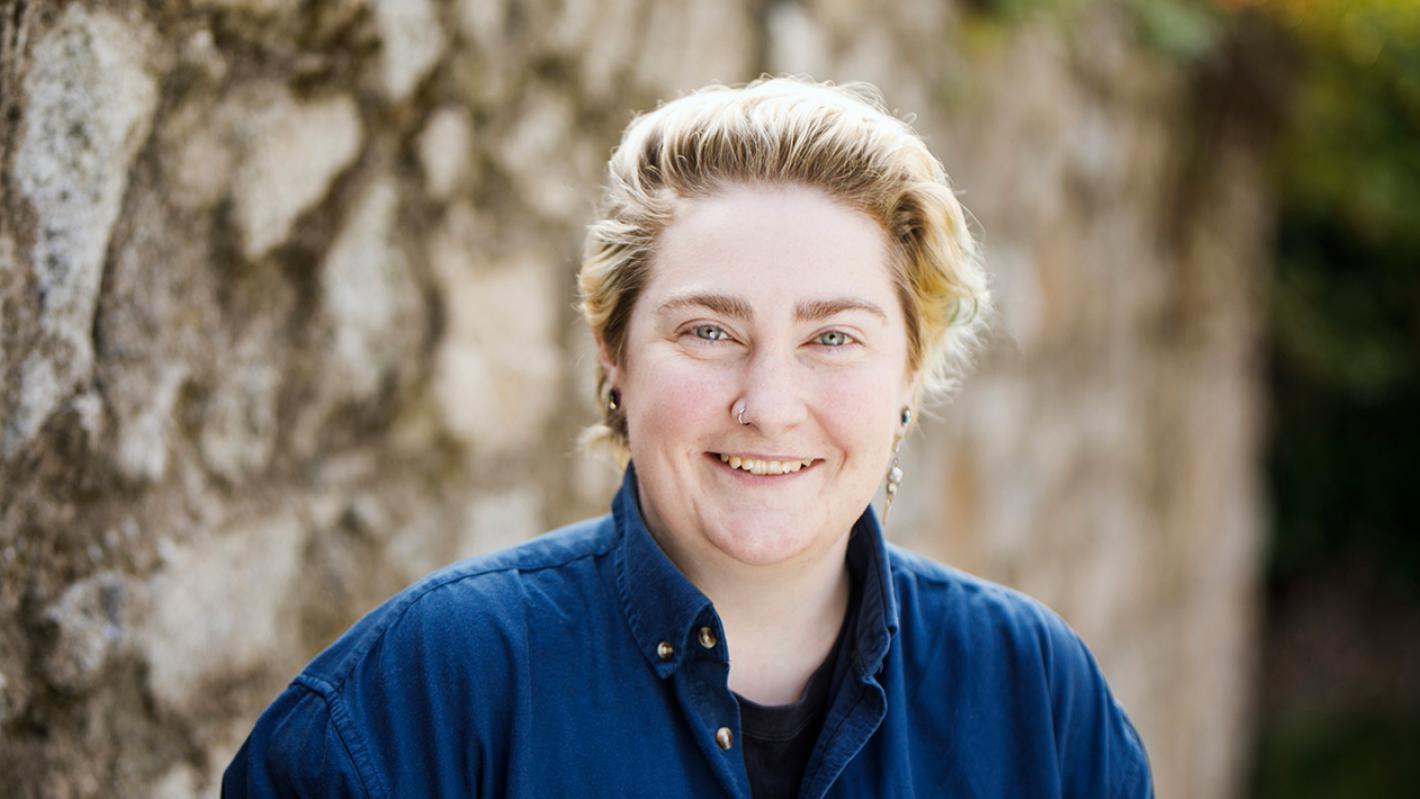
Cliona Rogan, Graduate Engineer at ROD.

This International Women in Engineering Day, we’re sharing the career story of Clíona Rogan, one of many talented women working at ROD
Cliona Rogan, Graduate Engineer at ROD.
I was really interested in maths in secondary school and had excellent teachers in the subject. In my final year, everyone, from my parents (who are both engineers) to my teachers, encouraged me to apply for engineering. I decided to go my own way, however, and applied for a mathematics course at Trinity College Dublin (TCD). Three years into the course, I realised that pure mathematics was just too theoretical for me, and I switched to engineering, instantly falling in love with the course.
In the second year of my engineering degree, Professor Alan O’Connor, Chair of Structural Engineering in the Department of Civil, Structural and Environmental Engineering at TCD, spoke to my class about his interest in bridges. He was wildly enthusiastic about bridges and made the area sound so cool that I decided to choose civil engineering as my specialism.
In my final year as an undergraduate, I spent eight months as an intern with the transportation team in RPS. I worked on a cycleway project and found it fascinating. As a result, when I was studying for my MSc at TCD, I chose transport classes in the main and picked a transport-themed topic for my thesis.
I remember ROD Director Lewis Feely speaking to me about the enhancing Motorway Operation Services (eMOS) Programme and showing me CCTV footage of incidents on the M50 motorway. It was the team’s involvement in variable speed limits (VSL) that caught my attention, as they have never been implemented in Ireland before and have the potential to make our motorways safer and more efficient, delivering a very real benefit for road users.
I joined the team on the M50 Traffic Flow Optimisation project, which involved the design and roll-out of the civil infrastructure required to support the operation of VSL on the M50. Initially, my job was to design the safety barriers, but I later got involved in the data analysis work, looking at the operational metrics for the motorway and seeing what insights I could extract from the data.
Getting involved at the very beginning when we were still researching the rules other countries, such as the UK and Australia, were using to set speed limits on their roads was exciting. We spent months working with An Garda Síochána, Dublin Fire Brigade, the operators in the Motorway Operations Control Centre and other stakeholders to determine the most appropriate rules for the Irish motorway network. The amount of logic that went into what seemed like the simplest decision was incredible.
Absolutely. Some people mistakenly believe that my job is all about coding, when in reality, it is highly collaborative, with a lot of looking at the big picture while also trying to understand and resolve specific issues identified by the motorway operators in the control centre. For example, when the contractor was appointed for the Network Intelligence and Management System (NIMS) scheme i.e. the computer system that replaced TII’s previous active traffic management system, there was a lot of work involved in gathering the initial requirements, setting out what the system should look like, listening to the feedback of the operators, and managing its phased delivery.
I’m working on the Data Fusion project, which is bringing multiple data sources together into a single operational picture, alerting operators in the control centre to detect incidents sooner, coordinating responses faster and improving overall network performance. My role is focused on supporting the development phase, combining my domain knowledge and data analytics skillset to help software developers to deliver better outcomes. I try to put myself into the shoes of the operators, so I can work out which alerts are useful to them and which represent an unnecessary distraction. If it is the latter, I help to design it out.
I am always going to be someone who likes to get her hands dirty on a project. I enjoy collaborating with others to get to the root of an issue and solve a problem. In the ITS team, I have found like-minded people and work that is constantly changing.